Design for Manufacturing: How Startups Can Turn Ideas into Scalable Products
December 22, 2025 • Cracent
Every hardware startup begins with a strong idea, but many fail not because the idea is weak—they fail because the product cannot be manufactured efficiently at scale. The gap between design and manufacturing is one of the most expensive and underestimated challenges for early-stage startups.
A brilliant prototype that costs ₹50,000 to build means nothing if it costs ₹35,000 to manufacture when your business model requires ₹12,000. A design that works perfectly in small batches but collapses at 10,000 units kills market opportunities. These aren't edge cases—they're the primary reasons hardware startups burn capital without reaching customers.
This is where Design for Manufacturing (DFM) becomes critical. DFM ensures that products are designed with real-world manufacturing constraints, costs, and scalability in mind from the very beginning.
This blog explains what DFM is, why it matters especially for startups, common mistakes founders make, and how a structured DFM approach reduces cost, risk, and time to market. Whether you're building for Indian markets or global expansion, understanding DFM is the difference between a fundable vision and a manufacturable product.
What Is Design for Manufacturing (DFM)?
Design for Manufacturing is the practice of integrating manufacturing considerations into every design decision from day one. Rather than creating an ideal design and then figuring out how to make it, DFM treats manufacturing constraints as design inputs that shape the product from the beginning.
Think of it as designing a building. An architect who ignores construction methods, material availability, and building codes creates beautiful renderings that cannot be built—or cost ten times the budget. Similarly, product designers who ignore injection molding constraints, assembly complexity, and material costs create products that cannot be manufactured profitably.
DFM asks critical questions throughout design: Can this geometry be molded without expensive side-actions? Will these tolerances require precision machining or can they accommodate standard processes? Can we source these components reliably at volume? How will assembly sequences affect labor costs? Can this design scale from 1,000 to 100,000 units without fundamental changes?
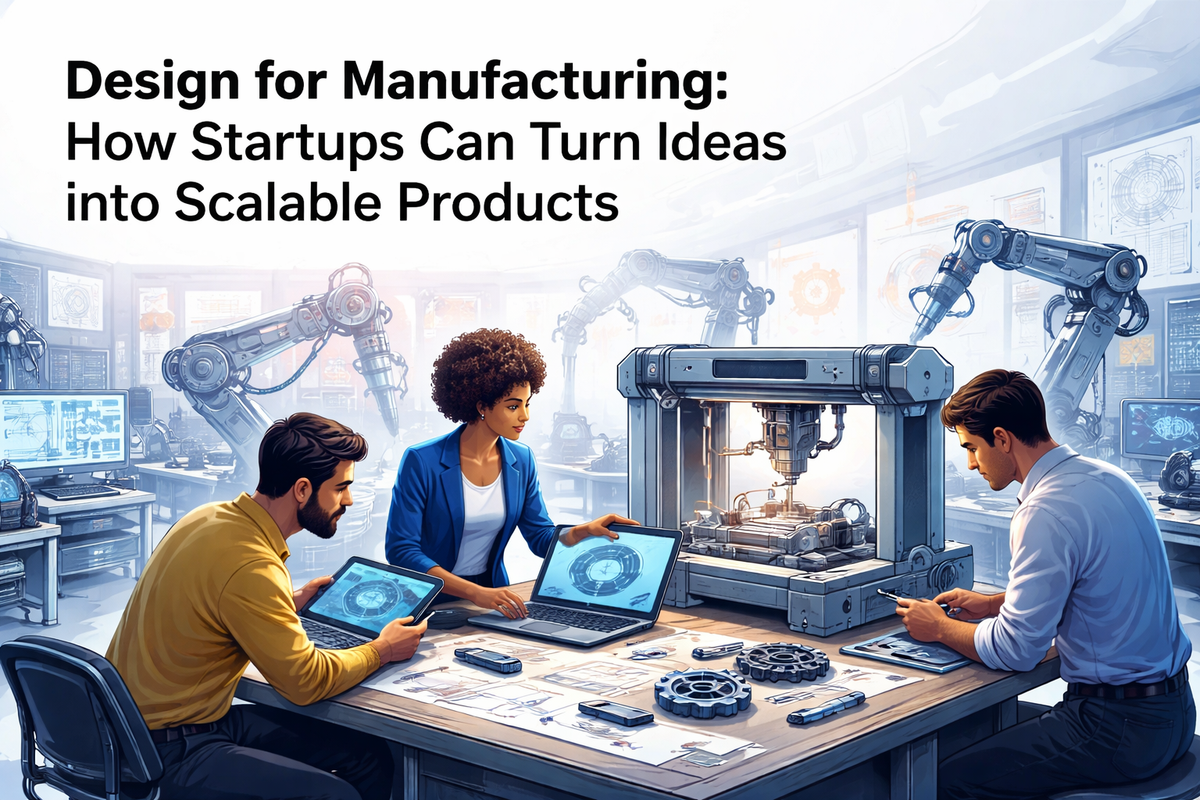
When applied correctly, DFM produces designs that are easier to manufacture, cost significantly less to produce, maintain consistent quality across production runs, and scale smoothly from pilot to volume without expensive redesigns. The goal isn't to compromise on functionality or aesthetics—it's to achieve those goals through manufacturing-intelligent approaches that work in the real world, not just in CAD software.
Why DFM Matters More for Startups
For large corporations with deep pockets and experienced teams, manufacturing mistakes are expensive setbacks. For startups, they're often fatal.
Capital constraints make mistakes unaffordable. When you've raised ₹2 crore and spent ₹15 lakhs on tooling for a design that can't be manufactured efficiently, you've consumed critical runway on a dead end. Unlike established companies that can absorb redesign costs, startups rarely survive expensive manufacturing pivots. Every rupee matters, and DFM prevents capital waste on unmanufacturable designs.
Investor scrutiny has intensified. Savvy investors now ask detailed questions about manufacturing feasibility, unit economics, and scalability during due diligence. A startup that can demonstrate DFM thinking—showing realistic cost models, identified manufacturing partners, and scalable production plans—has a significant advantage in fundraising. Investors have watched too many hardware startups fail on manufacturing execution to fund teams without credible production strategies.
There's no second chance to launch. Software startups can iterate quickly, fixing bugs and adding features post-launch. Hardware startups face a brutal reality: your first production run defines your market reputation. Products that fail due to manufacturing defects destroy brand credibility permanently. Customers don't distinguish between design flaws and manufacturing problems—they just know your product doesn't work.
Time to market determines winners. In competitive markets, the startup that reaches customers first often captures disproportionate market share. DFM accelerates development by eliminating costly redesign cycles, enabling faster ramp-up to volume production, and preventing manufacturing roadblocks that delay launch. Speed advantage compounds—earlier market entry generates revenue that funds growth while competitors struggle with manufacturing problems.
Common Mistakes Startups Make Without DFM
Designing without manufacturing knowledge
Most startup founders come from software, design, or business backgrounds with limited understanding of manufacturing realities. They create products that look stunning in 3D renders but present nightmares on the production line.
Common oversights include specifying impossible tolerances that would require aerospace-grade precision for a consumer product, designing parts that cannot be removed from injection molds without damage, creating assemblies where components must be installed in physically impossible sequences, and selecting materials incompatible with chosen manufacturing processes.
One startup spent nine months perfecting an elegantly curved enclosure, only to discover it required 5-axis CNC machining at 40 minutes per unit—economically impossible for their target price point. A design review with DFM expertise in week one would have identified this dead end before significant investment.
Manufacturing knowledge doesn't mean founders must become engineers. It means involving people with manufacturing expertise early, asking the right questions about producibility, and designing within the constraints of available processes. Ignorance isn't bliss—it's expensive.
Ignoring cost and scalability
Startups often obsess over functionality and aesthetics while treating manufacturing cost as a problem to solve later. This backwards approach leads to products that work beautifully as prototypes but become economically unviable in production.
A prototype built with 3D printed parts and hand assembly might cost ₹40,000 to produce. Founders assume this drops dramatically in production, but without DFM analysis, they don't realize their design choices lock in high costs. Custom fasteners, specialized components with single suppliers, and complex assembly requiring skilled labor—these add costs that don't magically disappear with volume.
Scalability issues emerge when designs that work for 100 units fail at 10,000. Quality becomes inconsistent, assembly bottlenecks appear, supplier capacity constraints surface, and yield rates drop. Redesigning for scale after committing to initial tooling is exponentially more expensive than designing for scale from the start.
Cost modeling must happen during design, not after. Understanding that your ₹50 retail price product needs ₹12-15 manufacturing cost should drive every material choice, every part count decision, and every process selection. Discovering cost problems after design finalization forces impossible choices: redesign and lose time, or proceed with broken unit economics.
Not involving manufacturers early
Perhaps the most damaging mistake is treating manufacturers as order-takers rather than partners. Startups finalize designs in isolation, then shop for the cheapest quote to build exactly what they've specified.
This approach misses invaluable insights. An experienced factory engineer can immediately spot problems: "This wall thickness will cause warping," or "These two components could be combined, cutting assembly time 40%." Manufacturers understand regional capabilities—what's easy to produce in Pune might be extremely difficult in Bangalore, and vice versa.
Early manufacturer involvement aligns design decisions with available capabilities, supply chains, and cost structures. It prevents the scenario where you've designed for processes your chosen manufacturer doesn't offer, or specified materials they cannot source reliably.
Waiting until design is "complete" creates an adversarial dynamic. The factory receives a fixed design they know has problems, and must choose between producing a flawed product or pushing back with expensive change requests. Starting conversations early creates collaboration where manufacturer expertise improves design before commitments are made.
The best manufacturing partnerships form during design, not during production. Treat manufacturers as technical advisors whose insights shape better products, not as vendors who execute orders without input.
The Design for Manufacturing Process (Step-by-Step)
Idea validation & R&D
DFM begins before detailed design starts. This phase validates whether your product concept is manufacturable at a viable cost, and identifies manufacturing constraints that should inform design direction.
Research manufacturing processes suitable for your product category. If creating a plastic device, understand injection molding, thermoforming, and alternatives. For electronics, learn PCB assembly, component sourcing, and enclosure manufacturing. You don't need expert-level knowledge, but you need enough to ask intelligent questions.
Create rough cost models early. Use parametric estimation or consult contract manufacturers to establish realistic cost targets at different volumes. If your target retail price is ₹3,000 and you need 50% margin for distribution, your manufacturing cost ceiling is ₹750-900 per unit. This constraint should guide every design decision.
Identify potential manufacturing partners and begin conversations. Even informal discussions provide insights into feasibility, typical lead times, minimum order quantities, and regional capabilities. These constraints become design inputs rather than unpleasant surprises discovered too late.
Conduct competitive analysis by reverse engineering similar products. Many seemingly arbitrary design choices are actually driven by manufacturing optimization. Understanding why competitors made specific decisions prevents reinventing solutions to manufacturing challenges they've already solved.
Design optimization
With manufacturing constraints understood, the design phase integrates DFM principles into every decision. This doesn't mean compromising on functionality or aesthetics—it means achieving those goals through manufacturing-friendly approaches.
Apply specific DFM principles relevant to your processes. For injection molding: uniform wall thickness, appropriate draft angles for mold release, avoiding undercuts requiring complex tooling, strategic parting line placement. For machined parts: minimize setups, use standard tool sizes, design features allowing efficient machining sequences.
Standardize components wherever possible. Using the same screw size throughout reduces inventory complexity and assembly errors. Designing multiple parts with common features enables tooling reuse and reduces setup costs. Every unique component adds complexity—each standardization removes it.
Design for assembly by minimizing part count, ensuring parts can only be assembled correctly (mistake-proofing), reducing or eliminating fasteners through snap-fits, and creating logical assembly sequences that don't require holding parts in place while installing others.
Material selection should balance performance requirements with availability, cost, and processability. Exotic materials may offer marginal performance improvements but create supply chain vulnerabilities and cost premiums. Common materials benefit from established supply chains, known processing parameters, and price stability.
Collaborate with manufacturing partners during this phase. Share design iterations early and incorporate feedback. A good manufacturer suggests optimizations maintaining your design intent while improving manufacturability. This partnership approach creates better products than isolated design work.
Prototyping & testing
Prototyping in a DFM context goes beyond validating functionality—it tests manufacturing assumptions and identifies issues before committing to production tooling.
Create prototypes using methods as close to final production as possible. If your product will be injection molded, prototype with CNC-machined parts or 3D printed parts simulating production material properties. If final assembly will be manual, build prototypes using intended assembly processes rather than ad hoc methods.
Test for manufacturing variability, not just nominal performance. Build multiple units to understand how component tolerances stack up, how assembly variations affect functionality, and where quality control points need establishment. One perfect prototype proves far less than ten prototypes with natural variation.
Conduct design validation testing focused on manufacturing concerns. Drop tests, thermal cycling, and accelerated life testing reveal whether material choices and construction methods will perform in real-world conditions. Finding that a snap-fit breaks after 50 cycles is far cheaper in prototyping than after producing 10,000 units.
Use prototyping to validate cost assumptions. Get quotes for production tooling based on finalized designs. Confirm component sourcing and pricing. Verify labor estimates by timing actual assembly. Prototypes meeting functional requirements but exceeding cost targets require redesign before production begins.
Document everything learned. Create assembly instructions, identify critical dimensions and tolerances, note supplier information for key components, record design decisions and their rationale. This documentation becomes the foundation for manufacturing readiness.
Manufacturing readiness
The final DFM phase prepares your design for volume production through comprehensive documentation, quality process establishment, and system validation.
Develop detailed technical drawings with appropriate tolerances, clearly specified materials and finishes, assembly instructions with visual aids, and quality control inspection points. These documents communicate design intent unambiguously to manufacturing partners.
Create a Bill of Materials listing every component with supplier information, part numbers, specifications, and lead times. This becomes your supply chain blueprint. Identify critical components with long lead times or single sources, and develop backup plans.
Establish quality standards and testing protocols. Define acceptable quality limits for critical dimensions and features, create go/no-go tests for functional validation, design testing performable efficiently in production environments. Quality systems designed upfront prevent disputes later about whether products meet specifications.
Conduct a pilot production run of 50-500 units using final tooling and processes. This reveals issues invisible in smaller prototype runs: tooling wear patterns, assembly bottlenecks, packaging challenges, supply chain coordination problems. Use pilot data to refine design. Minor modifications reducing assembly difficulty or improving yield have enormous impact multiplied across thousands of units.
Create ramp-up plans specifying how production scales from pilot to full volume, identifying resource requirements at each scale, and establishing quality gates that must pass before increasing volume. Ramping too quickly causes quality problems and customer dissatisfaction. Ramping too slowly creates cash flow issues and missed market windows. Strategic ramp planning balances these competing pressures.
How DFM Reduces Cost, Risk, and Time to Market
Cost reduction
DFM's most tangible benefit is reduced manufacturing cost. By designing with manufacturing processes in mind, startups avoid expensive materials, complex tooling, and labor-intensive assembly.
Part consolidation eliminates components and assembly steps. A product initially designed with 15 parts might optimize to 8 through strategic integration. Each eliminated part reduces material cost, eliminates an assembly step, reduces inventory complexity, and removes a potential quality issue. The savings compound—fewer parts mean fewer suppliers, less inventory management, reduced assembly labor, and lower quality risk.
Designing for standard manufacturing processes avoids premium pricing for specialized capabilities. Standard injection molding is dramatically cheaper than gas-assist molding or in-mold labeling, even though the latter might seem more elegant. DFM helps startups find the 80/20 solution achieving most of the desired result at a fraction of the cost.
Tooling costs decrease when designs follow DFM principles. Simple two-cavity molds cost far less than complex molds with side-actions and intricate details. A startup might spend ₹4 lakhs on DFM-optimized tooling versus ₹20 lakhs for tooling to produce a manufacturing-ignorant design. For cash-strapped startups, this difference is existential—it determines whether you can afford to launch at all.
Faster time to market
Speed to market often determines startup success. DFM accelerates development by reducing design iterations, preventing manufacturing roadblocks, and enabling faster ramp-up.
Getting design right the first time eliminates costly redesign cycles. Without DFM, startups often discover manufacturing problems late, requiring design changes triggering new prototyping, retooling, and revalidation. Each cycle consumes 2-4 months. DFM frontloads this learning, compressing 12-18 month development timelines to 6-9 months.
Manufacturing relationships established early through DFM collaboration mean production can begin immediately after design finalization. Without these relationships, startups face months searching for capable manufacturers, negotiating terms, and establishing trust. Time wasted on manufacturing partner churn can kill market opportunities while competitors launch.
Designs optimized for manufacturing ramp faster from pilot to volume. Simple, robust designs scale smoothly, while complex designs face quality issues and yield problems requiring troubleshooting and refinement. A product ready for 10,000 units per month after the first pilot run beats a competitor still debugging assembly issues three months later. That head start in market presence creates momentum difficult for followers to overcome.
Fewer failures and lower risk
Design failures waste capital, time, and team morale. DFM dramatically reduces failure risk by stress-testing designs against manufacturing reality before committing resources.
Many "innovative" designs fail not because the concept is flawed, but because execution is economically impossible. DFM identifies these dead ends early, before significant investment. A startup might spend ₹8 lakhs and two months validating a DFM approach versus ₹1.6 crore and ten months pursuing a manufacturing fantasy. The difference isn't just money—it's survival.
Hidden cost overruns destroy startups that raised capital based on projected manufacturing costs. DFM prevents the scenario where a product designed to cost ₹1,200 actually costs ₹2,800 to manufacture, invalidating the entire business model. Accurate cost understanding from the beginning enables realistic fundraising, pricing strategies, and business planning.
Quality issues arising from manufacturing problems damage brand reputation and create warranty exposure. Products designed without DFM often have structural weaknesses, assembly errors, or material failures appearing after market introduction. The cost of recalls, replacements, and lost customer trust far exceeds investment in proper DFM. One product recall can bankrupt an early-stage startup—prevention through DFM is vastly cheaper than remediation after launch.
Design for Manufacturing in the Indian & Global Context
Challenges faced by Indian startups
Indian hardware startups navigate unique challenges in implementing DFM, stemming from the developing manufacturing ecosystem and capital constraints.
Access to manufacturing expertise remains limited compared to mature hardware hubs like Shenzhen or Taiwan. While India has growing manufacturing capability, experienced DFM engineers and consultants concentrate in major metros, leaving startups in tier-2 and tier-3 cities with limited local resources. This knowledge gap leads to preventable design mistakes that more experienced ecosystems would catch early.
Capital efficiency pressures are more acute for Indian startups. With lower average funding rounds compared to Western counterparts, Indian founders have less margin for error on expensive tooling or manufacturing missteps. A ₹50 lakh mistake might be recoverable for a well-funded Silicon Valley startup but fatal for an Indian startup that raised ₹2 crore total. DFM becomes even more critical when you cannot afford a second try.
Supply chain challenges complicate DFM execution. While China offers mature component ecosystems where any part can be sourced locally, Indian startups often rely on imported components with long lead times and minimum order quantities. Designing around component availability is more complex when local sourcing options are limited. This requires more sophisticated supply chain planning and often forces design compromises based on what's actually available rather than what's ideal.
Manufacturing quality and capability vary widely. India has world-class manufacturers serving automotive and aerospace industries, but also countless small shops with inconsistent quality. Startups struggle to identify capable partners and often learn through expensive trial and error. DFM requires not just designing well, but matching designs to appropriate manufacturing capabilities—a challenge when capability assessment is difficult.
However, Indian startups also enjoy advantages. Lower engineering and prototyping costs allow more iteration on tighter budgets. Growing manufacturing capability in electronics, plastics, and metal fabrication provides options. Government initiatives like PLI schemes incentivize domestic manufacturing, creating opportunities for startups to build local supply chains with policy support.
Global manufacturing expectations
Startups aiming for international markets must design to global manufacturing standards, which often exceed domestic expectations.
Quality standards in developed markets are non-negotiable. Products sold in the US, Europe, or Japan must meet strict safety, environmental, and performance standards. DFM for global markets means designing for compliance from the start, not adding it later. This includes safety certifications (UL, CE), material restrictions (RoHS, REACH), and quality levels (AQL standards) that Western buyers expect. Retrofitting compliance is far more expensive than designing for it initially.
Documentation and traceability requirements are more stringent globally. International buyers expect comprehensive technical files, material certifications, quality records, and supply chain transparency. DFM processes must generate this documentation systematically, not scramble to create it when requested. Proper documentation also protects intellectual property and enables efficient contract manufacturing relationships.
Scalability expectations differ significantly. A product considered high-volume in India (100,000 annual units) might be viewed as low-volume elsewhere. Designs must accommodate volumes expected in target markets. A consumer electronics product designed for 100,000 annual units might struggle if opportunity emerges for 1 million units. DFM for global markets means designing scalability from the start—even if initial volumes are modest, the design should support 10x growth without fundamental changes.
Global supply chains offer advantages but require sophisticated management. Access to specialized components, advanced materials, and cutting-edge manufacturing processes enables product performance impossible with purely domestic resources. However, managing international suppliers, logistics, and quality control requires capabilities many startups lack initially. DFM must account for these complexities, balancing global sourcing advantages against coordination challenges.
How Cracent Helps Startups with Design for Manufacturing
Cracent bridges the gap between product ideas and scalable manufacturing by integrating DFM expertise throughout the product development lifecycle. From early-stage feasibility assessment to prototyping and manufacturing readiness, Cracent ensures startups design products that can be produced efficiently and scaled confidently.
End-to-end DFM integration: Rather than treating DFM as a separate phase, Cracent embeds manufacturing considerations into every design decision. Mechanical engineers optimize geometries for specific manufacturing processes. Electrical engineers design PCBs for efficient assembly and testing. Industrial designers balance aesthetics with manufacturing practicality. This multidisciplinary approach ensures all product aspects consider manufacturing implications from the beginning, not as an afterthought when problems emerge.
Access to vetted manufacturing partners: One of Cracent's most valuable offerings is its network of proven manufacturing partners across different processes and regions. Instead of startups spending months identifying, evaluating, and onboarding manufacturers, Cracent provides immediate access to injection molding facilities, sheet metal fabrication shops, PCB assembly operations, and final assembly facilities. This matchmaking prevents engaging manufacturers whose capabilities don't align with product requirements—a common and expensive mistake.
Comprehensive manufacturing readiness: Cracent manages the critical transition from prototype to production, coordinating pilot runs, refining designs based on manufacturing feedback, establishing quality systems, and developing supply chains. This phase is where many startups stumble—their design works in prototype but fails in production. Cracent's experience navigating this transition prevents the costly surprises that derail hardware launches.
Single platform accountability: By connecting startups with vetted manufacturing partners and managing the design-to-production journey on a single platform, Cracent reduces costly redesigns, shortens development cycles, and helps founders avoid manufacturing pitfalls that derail hardware startups. Rather than managing relationships with separate design consultants, prototyping services, and manufacturing brokers, startups work through Cracent as a unified partner. This integration creates efficiency and accountability—design decisions consider downstream manufacturing implications because the same team manages both.
For founders without hardware experience, this consolidated approach is transformative. Rather than learning manufacturing the hard way through expensive mistakes, they leverage Cracent's expertise to navigate product development successfully the first time. The result: products that reach market faster, cost less to produce, and scale smoothly from pilot to volume production.
Design for Manufacturing represents the difference between startups that successfully bring hardware products to market and those that burn capital on unmanufacturable dreams. It's not an optional nicety for cash-rich companies—it's survival strategy for resource-constrained startups.
The startups that thrive integrate DFM thinking from day one. They view manufacturing not as a problem to solve later, but as a design constraint to embrace from the beginning. They involve manufacturing partners as collaborators, not vendors. They iterate designs with both functionality and manufacturability in mind.
This approach requires humility and discipline, but the payoff is enormous: products reach market faster, cost less to produce, and scale smoothly. Capital is preserved for growth rather than wasted on redesigns.
Whether you're creating India's next innovative hardware product or designing for global markets, the path from idea to scalable product runs through Design for Manufacturing. Choose proactive. Choose DFM. Choose partners who bring manufacturing expertise from your project's first day.
🚀 Building a Hardware Product?
Cracent helps startups transform ideas into manufacturable, scalable products through structured R&D, DFM-led design, prototyping, and manufacturing support.
📩 Get in touch with Cracent:
- Website: cracent.com
- Email: info@cracent.com
- LinkedIn: Cracent
Cracent provides engineering, design, and manufacturing enablement services. Final manufacturing outcomes depend on supplier capabilities and project requirements.